By Donald H. Harrison
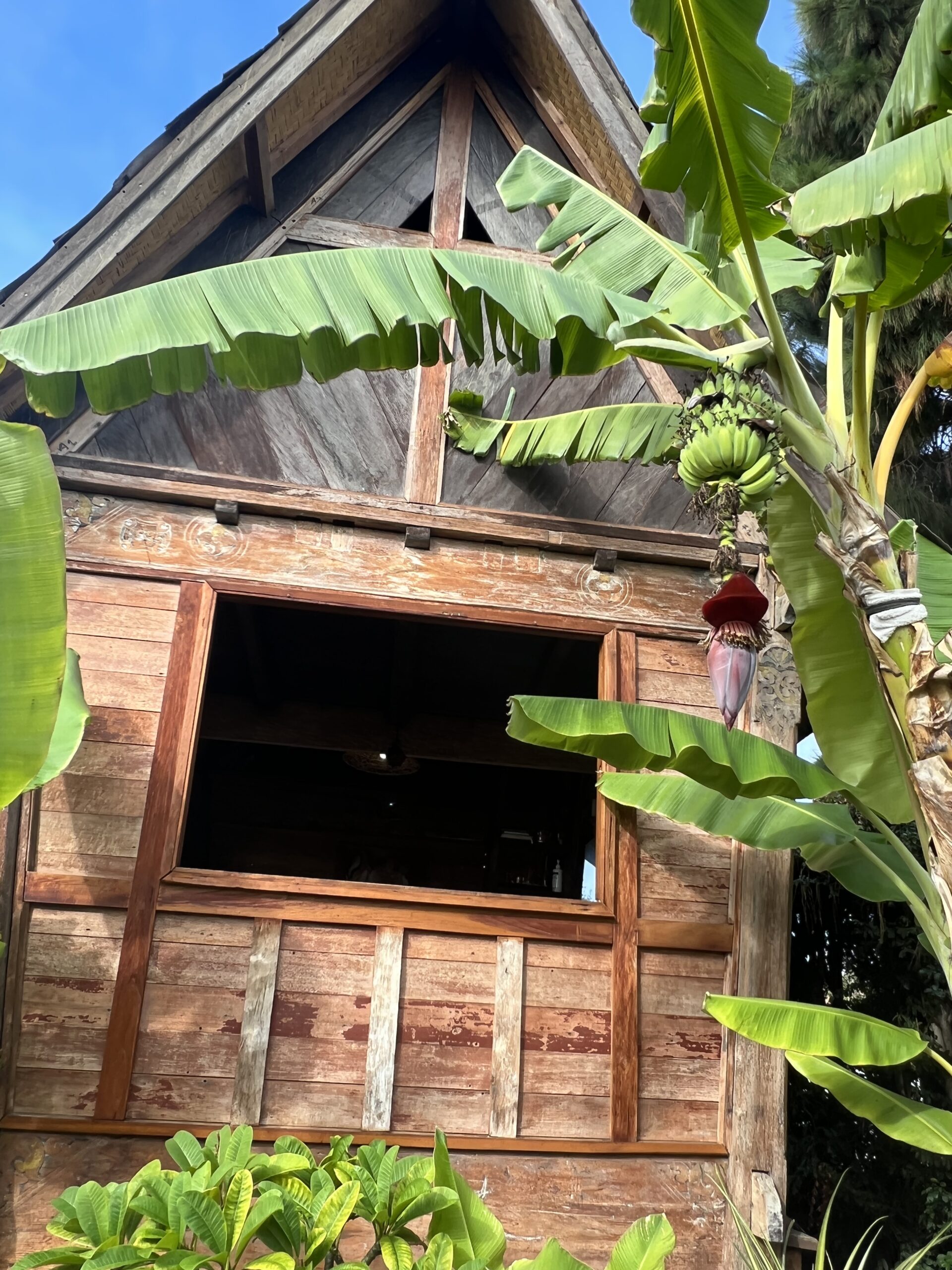
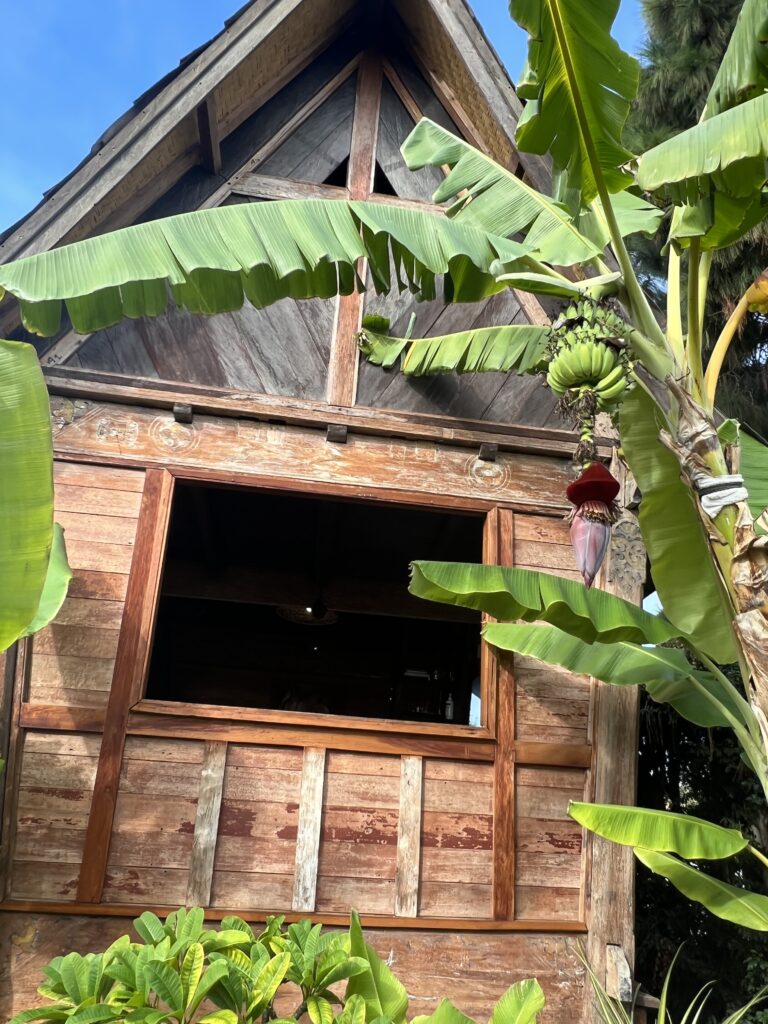
SAN DIEGO – Dragon fruit, passion fruit, pineapples, and bananas may be found growing outside the Indonesian rice house that David and Indri “Rie” Sims have converted into a small restaurant in the backyard of their home in the Serra Mesa neighborhood. In another section of the garden is a large array of pots where the Sims grow 80 varieties of small plants, many of them spices to flavor the six-course dinners they serve inside the rice house.
Welcome to the Warung Rierie, a unique and pricey ($185 per person) small eatery where you and your guests have the exclusive attention of your chef (Rie) and your waiter (David). The fixed-menu meals they serve will allow you to experience many subtle flavors of Indonesia while learning about the culture of Bali, one of Indonesia’s five main islands and the place where David and Rie met in 2005.
This particular rice house was built in 1935 from teak and ironwood in a tiny village in western Sumatra, David informs visitors. “Villagers would harvest the rice out in the paddies and then put it into big sacks and store them in the rice house. A lot of them would take a ladder that was on the outside up to the loft and sleep there. When the rice house was empty, they would use it as a communal house. It wasn’t a single person’s ownership; it belonged to the whole village.”
The Sims family have a Balinese friend who, as part of his woodworking business, travels “all over the archipelago—there are over 17,000 islands in Indonesia—finding these vintage structures and bringing them back to Bali, where he fixes them up and resells them. This was his actual office from which he would sell the other ones.”
While revisiting Bali in 2019, the Sims decided they would like to have that rice house in their backyard, which abuts the Harry Wegeforth Elementary School, named for the founder of the San Diego Zoo.
Moving the rice house was no small undertaking. “He and his crew had to dismantle the house, and crate it by hand because all the boards and beams are different,” David recalled. “They had to custom build wood crates for it, and it came over in a container, 11,000 pounds total. When it came here, right before COVID, we flew him out here and I have some friends who are construction contractors. Our friends had seen pictures in Bali so they were excited to help. My cousin is a heavy equipment crane operator and he said ,‘If you do it on a Sunday, I can bring one of my crane out.’ He came out with a massive 12-wheel crane with a 120-foot arm on it. In 6 ½ hours we had the entire frame up.”
The interior of the house measures approximately 12 feet by 13 feet. Over the next month, David and his Indonesian friend assembled the roof, “which was tricky because we didn’t have any scaffolding.”
David, a San Diego native who has taught surfing and lifesaving, initially went to Bali because it “is a Disneyland for surfers, very popular in the surf community. I wanted to try the perfect waves of Indonesia.” He stayed for three weeks, during which time the fellow Californian who owned the small hotel where he stayed said he was hoping to find someone to manage the property. David promptly volunteered, and “that following April I packed my stuff, jumped on a plane to Bali, and didn’t come back for six years. During that time, I met my wife.” Rie, who has experience as a cinematographer, at the time was managing a surf school fostered by Billabong, the sports clothing manufacturer.
“It was love at first sight,” David related. “We got along like we had been friends for our whole lives. After a year we decided to get married.” They also decided to become partners in a business called Bali Kids Camp. It was a “small VIP business where you would pick up a child at their villa, wherever they were staying, and take them to this all-inclusive camp with surfing, snorkeling, beach games, and eating healthy food. We’d drop them off at the end of the day. My wife would take pictures the whole day.”
David described Bali as a “melting pot of cultures from around the world. There is a large Russian contingent, folks from India, people from Ireland and Israel. There a lot of people who surf out of Israel, you’d be surprised. The thing about Bali is that it is a happy place. You go there and the vibe is such that you step off the plane and everyone is in a good mood. Strangers meet and make plans together; ‘Hey I’m going to hike this volcano.’ ‘That sounds cool.’ ‘Come with me.’ We tell people when they come to Bali, don’t make hard plans. Find points of interest that you think that you want to do and then just see what happens.”
Balinese culture has become a part of David—literally. On his left side is a tattoo of Barong, “a protector God in Balinese folk lore. He is kind of a jokester or a prankster, which is me to a tee.” On his right arm is Randag, “an evil deity” with whom Barong is in eternal conflict. They are the Yin and the Yang.
Rie related that “Indonesia has five big islands and five big religions. We have Muslims, Christians, Catholics, Hindus and Buddhists. In fact we have the largest Buddhist temple in the world.” Also in Bali is an area they call “Five Temples” where temples of those five religions are side-by-side in a demonstration of unity.
(In Indonesia, which does not have diplomatic relations with Israel, there are some Jews, who list on their national identity cards “Belief in One Almighty God” because Judaism is not an officially recognized religion. According to Wikipedia’s article on “History of the Jews in Indonesia,” there are or have been tiny congregations in Jakarta, East Java, and Sulawesi.)
Reservations are required far in advance for either of Warung Rierie’s two dinner services on Thursdays, Fridays, and Saturdays—the first being from 4 to 6 p.m., the second from 7 p.m. to 9 p.m. Dinners consist of traditional Indonesian food, “not edible art but the presentation is elevated,” says David. “You go home stuffed to the gills and then some – we offer take-home boxes. We change the menu every month. This month we serve a traditional Indonesian corn fritter with a sweet chili dipping sauce as an appetizer; next, a jumbo tiger prawn and a fish in a butter sauce; followed by a yellow coconut soup; a citrus salad with beets; a slow cooked round steak in rendang sauce, which is a ground coconut curry, complimented with yellow rice suffused with turmeric and coconut; fried noodles, and homemade pickled vegetables.” Dessert is similar to bananas foster.
If you care for coffee with your meal, there are several varieties, including kopi luwak, which is one of mot expensive coffees in the world. Civets consume the coffee berries but excrete the coffee beans without digesting them, in the process favorably altering their flavor. The beans are then washed and boiled and “the taste is very smooth,” according to Dave. Patrons who don’t want to do “civit duty” have other coffees or several teas to choose from.
Warung Rierie’s reputation brought Chef Yono Purnomo of Albany, New York, on a visit for three days. Purnomo, owner of the Four Star Yono’s Restaurant and a winner of international competitions, ate at Warung Rierie the first night, and, impressed, he joined Rie in the kitchen the next night. “And then the third night, we were just sitting there until 1 p.m.,” Rie recalled. “It was like my dad telling me stories. He had a cigar and porto wine, and wrote in our guest book that ‘this is like my grandma’s house.’”
###


